




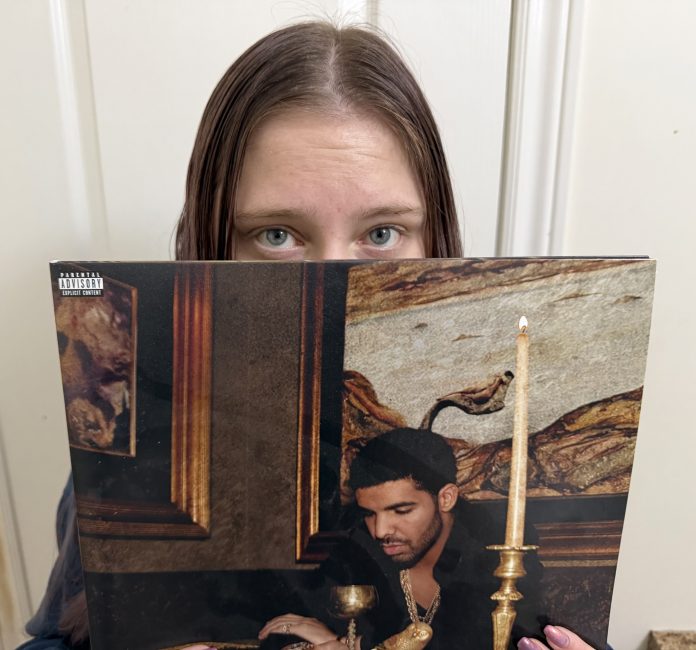

Two years removed from his historic rap feud with Kendrick Lamar, Canadian singer/rapper Drake has had an eventful 2026. In May, he came out swinging with a triple-album release consisting of the rap-focused ICEMAN, the R&B project HABIBTI and the experimental dancehall album MAID OF HONOUR. Now, Drake is back again with HABIBTI (FOMO), a deluxe edition featuring three new records and an extended version of “Classic.”
While Drake has incorporated R&B throughout his career, HABIBTI sees him fully embracing the genre, with occasional rap elements on records such as “Quebec,” “Slap The City” and “I’m Spent.” However, the album’s greatest strength lies in its melodic songwriting and its portrayal of modern-day relationships.
Four songs can be interpreted as an overarching relationship narrative. “Classic” captures the excitement of meeting someone new. On “Gen 5,” the cracks in the relationship begin forming as Drake questions whether he’s qualified to be his partner’s boyfriend, apologizes without understanding what he’s done wrong and describes increasingly hostile interactions.
Meanwhile, “Fortworth,” featuring PARTYNEXTDOOR, finds Drake pleading with his partner not to let her friends convince her their relationship meant nothing. By “White Bone,” he recognizes that the relationship is falling apart but struggles to let go, believing he has found his soulmate.
The deluxe edition adds another chapter to that story. “Cold Shoulder,” featuring Don Toliver and Yebba, acts as an emotional continuation of “White Bone.” Drake acknowledges his partner has left but remains determined to reconcile. Rather than providing a satisfying conclusion, the song portrays someone who understands the relationship is over but cannot emotionally accept it.
Another standout record is “Solar Eclipse” featuring Don Toliver, which interpolates Ella Langley’s country record “Choosin’ Texas” while sampling Drake’s own “N 2 Deep.” The result is a melodic R&B and hip-hop hybrid with mainstream appeal.
However, there’s more than meets the eye. Drake is quite literally choosing Texas by reworking a country record, collaborating with Houston native Don Toliver and potentially paying homage to the late DJ Screw, a pioneer of Houston’s chopped and screwed sound. These connections add layers to an otherwise mainstream record.
Throughout “HABIBTI (FOMO)” we hear Heartbreak Drake at his best, offering relatable portrayals of relationships through introspective songwriting, melodies and harmonies. What’s particularly interesting is that one of Drake’s biggest experiments is defined by a sound he has spent more than a decade refining.
The album draws similarities to his 2011 release Take Care, which earned him a Grammy for best rap album. Although categorized as rap, its atmospheric production, emotional vulnerability and combination of singing and rapping helped establish the dark Toronto R&B sound that became central to Drake’s career.
On “Marvins Room” we hear Drake drunkenly calling a former lover who has moved on, struggling with jealousy and loneliness. “Shot For Me” approaches former relationships with resentment and lingering attachment, while “Good Ones Go (Interlude)” explores his fear of losing someone permanently.
Those emotions return on HABIBTI (FOMO). “Gen 5” revisits relationship insecurity, “White Bone” reflects the desperation once heard on “Marvins Room” and “Cold Shoulder” resembles “Good Ones Go (Interlude)’ through its reluctance to let someone go. Unlike Take Care, HABIBTI and HABIBTI (FOMO) develop these themes into a narrative across an R&B-focused album.
Drake’s decision to release three stylistically different albums also reflects his diverse audience. Some listeners prefer his rapping, others gravitate towards his R&B records, while others enjoy his club music. Critical reception to the original HABIBTI has been mixed, with varying opinions among online reviewers. Nonetheless, its commitment to melodic songwriting is precisely what makes the project successful for listeners who appreciate that side of Drake.
The album isn’t without weaker moments. “Rusty Intro” is very self-aware, with Drake acknowledging he’s rusty, but its instrumental and off-beat vocals make it an underwhelming listen. “Hurrr Not Thurrr” also suffers from a massive tonal shift. Drake begins the record by expressing his infatuation with a woman, only for Sexyy Red’s sexually explicit verse to disrupt the romantic atmosphere.
Despite these shortcomings, HABIBTI (FOMO) is a successful experiment. Its greatest strength isn’t that Drake is reinventing himself, but that he’s embracing the introspective songwriting and melodic production that have defined his career. From the excitement of a new relationship to the desperation of saving one, this project demonstrates why Heartbreak Drake remains one of his most recognizable artistic identities.