




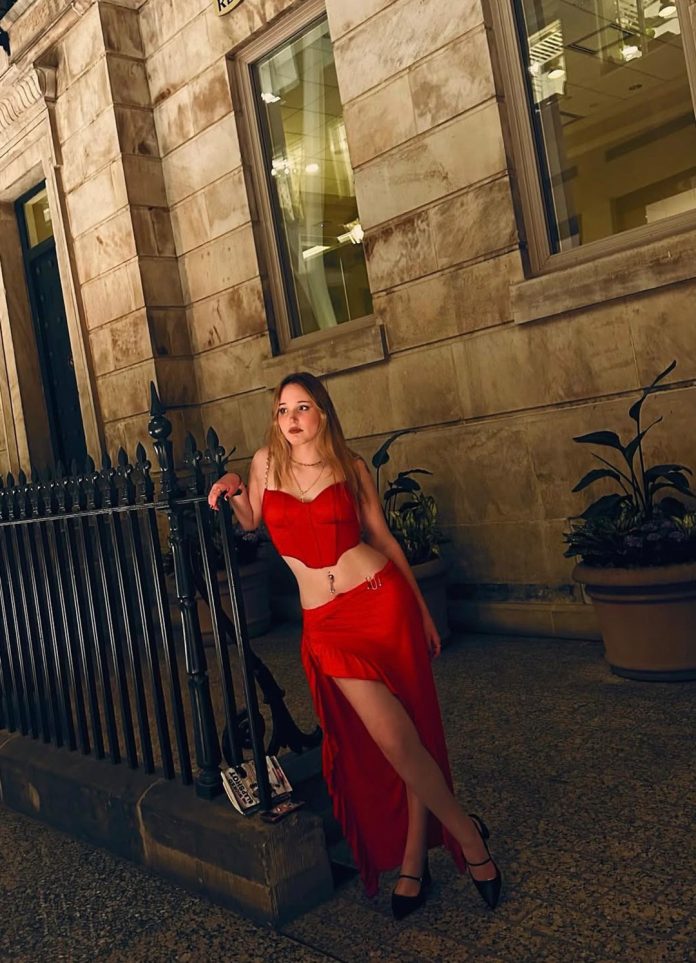

Fashion has become one of the most closely monitored creative industries in public culture. Thin models are often accused of promoting unrealistic standards, while plus-size representation is pulled into opposite appearance-based arguments.
Social media plays a major role in how these images are interpreted.
A 2025 review by Jiménez-García and colleagues, published in the Journal of Eating Disorders, looked at 56 studies on how body-positive content affects body image online.
They found that seeing diverse and accepting images of bodies can improve people’s body satisfaction and mood, at least in the short term, though it doesn’t always stop people from comparing themselves to others.
This influence shapes how people interpret all kinds of body imagery online, whether emphasizing slender figures, plus-size figures, or anything in between.
It is also worth stating clearly that choosing thin models is not, by itself, an unethical act. Thin bodies exist naturally, just as many other body types do.
Their presence in fashion imagery is not automatically a message about what bodies should look like.
If fashion is understood as a visual medium, designers must be allowed to work with a range of body types, including thin ones, without every casting choice being framed as harm.
While broader representation has brought meaningful progress, the conversation often overlooks a key point: fashion is not just a business. It is also a visual art form built on creative vision and aesthetic direction.
Designers don’t simply make clothing; they construct collections around shape, structure, and movement. The body becomes part of the composition that brings garments to life.
Just as filmmakers cast actors to fit a role or painters choose subjects to create a particular mood, fashion designers select models who best express the visual identity of their work.
Some critics argue that this practice prioritizes aesthetics over social responsibility, insisting that brands should represent every body type equally. These perspectives are important to consider, but expecting universal representation risks treating fashion like a social policy tool rather than a creative industry.
Art depends on distinct vision, not universal sameness, particularly regarding size.
Expecting every brand to cast the same range of bodies flattens artistic individuality.
The push for inclusivity has increased visibility for people previously excluded from fashion spaces, for example, Ashley Graham, who only recently appeared in the 2024 and 2025 Victoria’s Secret Fashion Show.
However, in many cases, inclusivity has shifted from meaningful progress to performance, such as major fashion weeks, where plus‑size and mid‑size models account for only a tiny proportion of runway looks.
According to The Vogue Business Autumn/Winter 2025 size inclusivity report, for example, only 0.3 per cent of the 8,703 looks across 198 shows and presentations were modelled by plus-size models.
Not every brand is designed for every consumer, and not every consumer needs to be served by every label.
This understanding of fashion as art is supported by cultural institutions.
In a 2012 discussion published in Fashion and Art, Pamela Golbin, former curator at Paris’s Musée de la Mode et du Textile, states that “Fashion, like all other arts, has its place within a museum gallery.”
Her work helped establish fashion as a legitimate artistic practice rather than mere consumer production.
When fashion is viewed this way, casting becomes part of creative direction, not a moral obligation.
Fashion has always operated through niche markets and distinct identities. Demanding universal representation across all houses risks reducing the industry to uniformity.
Fashion has always been aspirational, stylized, and selective, and that selectivity fuels creativity and cultural influence.
Fashion does not need to abandon its artistic identity to be socially aware. It needs space to create, and an audience prepared to engage with art critically.