




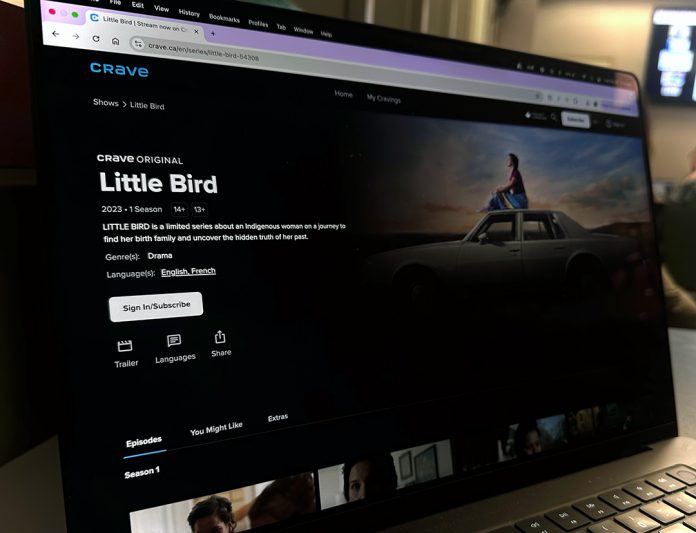

Little Bird is cinematic television because it serves as an invitation demanding viewers to sit with discomfort and confront a chapter of Canadian history that is far too often ignored.
Created by Jennifer Podemski and Hannah Moscovitch, and produced jointly by Crave and APTN, the six-part limited series premiered in May 2023. It is a quiet, unflinching exploration of the Sixties Scoop that privileges lived experience over exposition.
The Sixties Scoop, spanning the 1950s through the 1980s, saw thousands of Indigenous children forcibly removed from their families by Canadian child welfare agencies and placed into foster or adoptive homes, often with non-Indigenous families.
Framed at the time as a form of “rescue,” the policy severed cultural and familial ties, leaving generations to wrestle with lost language, identity and heritage.
At the centre of the story is Bezhig Little Bird, played with quiet intensity by Darla Contois. Taken from her family in Saskatchewan in the late 1960s and raised by a Jewish family in Montreal, she now lives as Esther Rosenblum, a law student seemingly anchored by her adoptive community. But a casually racist remark at her engagement party forces her to confront the trauma, love and loss stitched into her family’s past.
Contois delivers a masterclass in restraint through her acting. Esther is defined by what she holds in, with small pauses and fleeting glances carrying decades of pain.
Ellyn Jade’s portrayal of Patti Little Bird, Esther’s mother, is heartbreaking: a woman denied agency, language and recourse, yet fiercely devoted. Osawa Muskwa, as Esther’s sibling, brings both tenderness and confusion, reflecting the long shadow of state-sanctioned separation.
Every performance feels lived-in, allowing audiences to experience the weight of these historical injustices firsthand.
The series avoids the simplistic depiction of social workers as villains. Instead, it shows how their conviction in “doing good” makes the harm they cause chillingly real.
At the same time, moments of tenderness and hope emerge, demonstrating that even lives marked by trauma can be threaded with connection and love.
Little Bird’s dual timelines flipping between Saskatchewan in the late 1960s and Montreal and Saskatchewan in the 1980s, mirror Esther’s fractured sense of self.
Childhood scenes are warm and intimate, offering glimpses of family bonds the state sought to erase. We are shown how the open prairies contrast sharply with the confinement of urban Montreal, grounding the emotional journey in physical space.
The relationship between Esther and her adoptive mother, Golda (Lisa Edelstein), adds further complexity. Golda, a Holocaust survivor, carries her own history of loss and state violence. Love exists alongside fear and silence, echoing the paternalism that allowed the Scoop in the first place.
Ultimately, Little Bird is a subtle, layered depiction of trauma and survival intersecting across cultures. It is both a historical reckoning and a deeply human story which lingers long after the credits roll.