




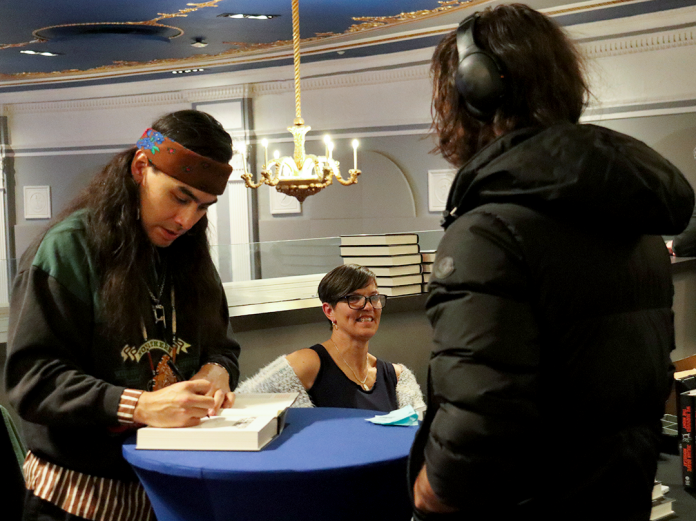

Some audience members say a recent event featuring the Oscar-nominated filmmaker Julian Brave NoiseCat helped them with their ongoing journey to learn about truth and reconciliation.
NoiseCat, 32, presented his new book “We Survived the Night” at the Faculty of Social Science and Humanities Dean’s Public Lecture at Regent Theatre in downtown Oshawa.
Farah Eshraghi and Orquidea Castillo, friends from Durham Multi-faith Community, attended the Nov. 11 event. With their group, they have taken the University of Alberta’s Indigenous Canada Course and read the book “Braiding Sweetgrass” by Robin Wall Kimmerer.
Eshraghi, originally from Iran, explained she has been walking the path of reconciliation for the last couple of years. She enjoys going to Indigenous centred events and ceremonies.
“It’s important as settlers in Canada to learn about the Indigenous culture,” which she finds enriching, and highlighted the importance of “becoming allies with our indigenous friends,” she said.
Eshraghi, who saw the screening of NoiseCat’s documentary “Sugarcane” when it was presented in Oshawa, was looking forward to the book launch, to which she invited Castillo, an immigrant woman from Honduras.
Castillo, who has been living in Canada since 2008, became interested in learning more when she heard the news about “the discovery of the children in the graves that were not marked.”
That’s when she started to learn more about Indigenous history in Canada and reconciliation.
For Castillo, truth and awareness are fundamental for reconciliation.
“Everyone, it’s not only the government. Each one of us needs to learn the truth, needs to learn what happened,” to be their partners in the reconciliation effort.
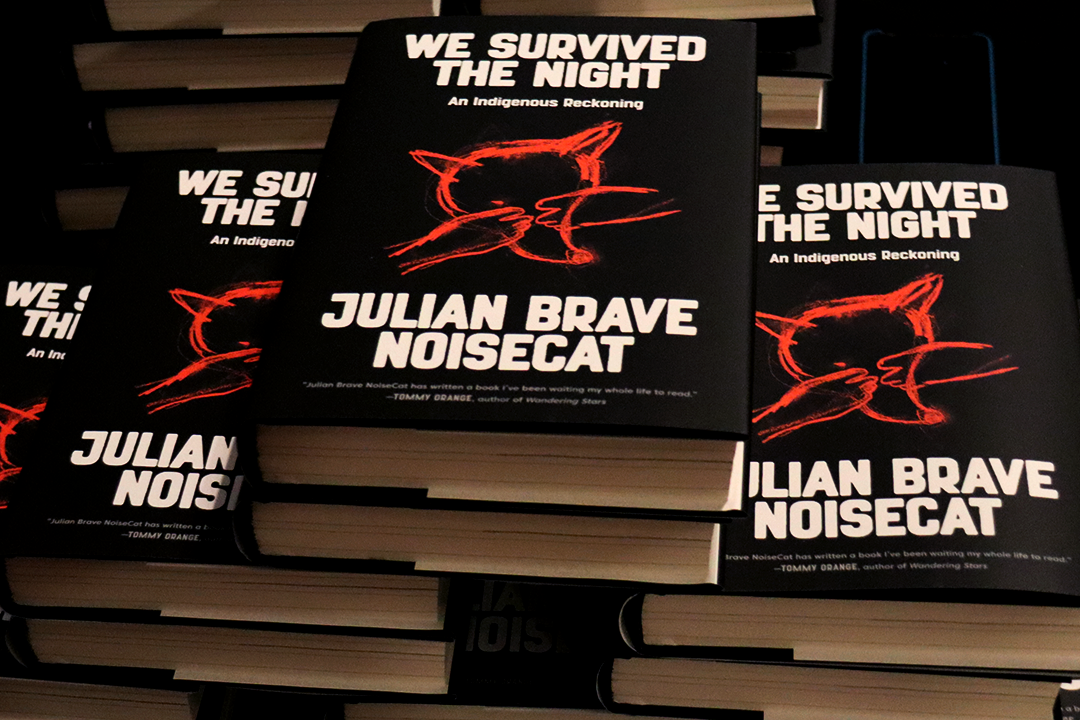
Awareness is what NoiseCat wants to bring with ‘We Survived the Night,’ a book he started writing at 28-years-old when he moved in with his dad, who he had only seen intermittently throughout the years.
His first book tells his family story by retelling Coyote’s story, a trickster figure important in the creation stories of “Indigenous peoples, all the way from Central America to Western Canada.”
He heard it for first time from his uncle, “the best Indian cowboy.”
Coyote is featured on the front cover of his book. The art, called Coyote sees the world clearly, is a piece by Jaune Quick-to-See Smith, who died at 85 earlier this year.
It is a licensed image based on a pre-existing drawing by Smith from 2009. A graphic designer was granted permission to make a colour adjustment to for the sake of the design, according to the Garth Greenan Gallery which represents Smith’s estate.
NoiseCat said Smith is one of “the most significant painters in the last century,” not just U.S. painters, or Native American painters, but painters full stop.
In his first book, NoiseCat breaks some of the rules set for non-fiction literature by having “tricksters, mythological ancestors, the supernatural, the beyond involved in the events of the here and now.”
He says this choice is because the stories Indigenous people tell have been true to the land for all time. He sees how the mythological essence of Coyote’s story unfolds in real life through colonialism and “Indigenous survival in the wake of genocide.”
Tscwinúcw-k or “We Survived the Night,” the title of the book, is a morning greeting in Secwepemctsín, his people’s language, now spoken fluently by only two living people on his reserve: his grandmother, and her sister.
That phrase, which he saw on the mug his grandmother used every morning, made him think about what it meant.
For example, the winter of 1863 “when two-thirds of our Nation died of smallpox” or the mornings after children were taken away on the back of cattle trucks to St. Joseph’s Mission, the residential school where the book opens.
NoiseCat was raised in the U.S., but is a member of B.C.’s Canim Lake Band, Tsq’escen, and a descendant of the Lil’Wat Nation of Mount Currie.