





Shannon Busta-Riches, the senior manager of opinion audio at The New York Times, was on vacation with her husband in the Caribbean last winter, when a surprising conversation started with another Canadian couple. The topic landed on Andrew Huberman’s podcast and Busta-Riches asked for their thoughts on The New York Magazine feature written about him.
The feature had revealed bad information about Huberman’s character.
The couple asked if Busta-Riches believed the article was real, saying that journalists make things up.
“And this was before I think we had gotten around to noting that we were journalists,” Busta-Riches says.
It was an “illuminating” moment for Busta-Riches about what people think of journalism.
The belief that journalists deceive fits right in with Reuters Institute Digital News Report for 2025 which shares traditional news media is struggling with low trust and connecting with the public.
“I think that an unfortunate percentage of society questions whether or not journalists follow the best practices and guidelines and ethics that we’re trained to do,” says Busta-Riches. “I think that’s in part because the general public just has no visibility into how we’re trained.”
“The public doesn’t understand how media works and how journalism works,” says Brent Jolly, president of The Canadian Association of Journalists (CAJ), who makes the analogy of comparing journalism to looking at the ingredient list of a food item at the grocery store. When looking at a list of ingredients that go into the product, people can decide if that is something they’re good with eating.
“I think journalism is kind of a bit like that in the same way, but we don’t do a very good job of describing sort of what goes into it,” he says.
The News Literacy Project survey revealed American teens believe that journalists deceive more than they inform the public. As many as 50 per cent think journalists make up quotes and other details.
As the survey explains, the internet constantly surrounds teens with attention seeking posts and misinformation disguised as news which results in distrust in the media.
Historically, journalism has evolved alongside technology. From the invention of the printing press to the radio, to the internet and podcasts to social media. What is different in this current media landscape is the source which holds the power of sharing content, according to The Shattered Mirror.
“Old media is dying, but new media is developing,” says Busta-Riches, who has also worked at The Globe and Mail. “It’s incumbent on us to harness those and be present on those platforms to ensure that our standards are there, that the foundations of journalism are there.”
Angela Murphy, foreign editor at The Globe and Mail, says people are consuming the news from social media due to time pressure. “Everything has sped up, so people always feel time pressure to do things,” she says.
To Murphy, these platforms offer “the quick hit” dopamine effect while it takes longer to sit down and read a written piece.
“I’ve accepted that nothing is static, that everything will continue to change and that change provides opportunity,” says Brodie Fenlon, editor in chief at CBC News.
Fenlon says all news organizations are “in the same boat” when it comes to navigating the new media landscape.
Since he says every generation consumes news differently, news organizations need to “find a way to serve all those people and be relevant to them.”
Fenlon explains how CBC is mindful of social media by having a presence on TikTok and YouTube to reach the younger audiences.
“We need to go where they are,” he says.
As the media landscape is filled with misinformation, Fenlon says that it’s an opportunity for CBC to position themselves as a place people can trust.
CBC has also come out with new 2025 AI guidelines for their journalists to follow.
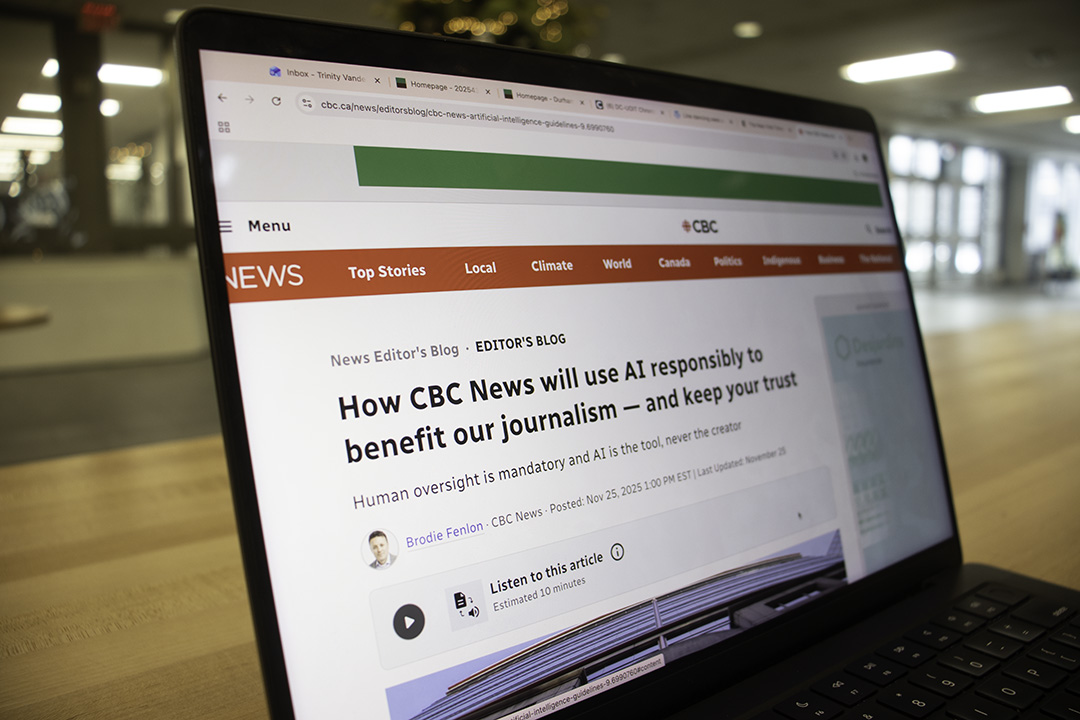
“Today, there’s so many tools and so many use cases that we thought we need to provide a little more detail on what you can and can’t do with AI,” says Fenlon.
These guidelines say “At CBC News, our focus is on AI-assisted work.” That means AI is used as a tool while the journalist remains as the primary creator of the work. The new guidelines do see new opportunities as using AI “in an assistive capacity.” For example, using AI to analyze data.
Reuters’ 2025 report says AI chatbots are being used as a source of news, particularly for younger audiences. On top of this, a 2025 survey from The Canadian Journalism Foundation reveals that 43 per cent of Canadians have encountered AI-manipulated content online.
According to The Center for News Technology & Innovation, the issue with using AI for news is that it is capable of sharing false and made-up information in a convincing way.
This September, Busta-Riches says she had her own experience with misinformation and AI. “I asked ChatGPT something and it said Donald Trump is not president, Joe Biden is president,” she says.
Jolly says that while people say AI is bad, it isn’t going away.
“You can sort of stomp your feet and pound the pavement and say, ‘oh this is terrible, and it’s going to take my job,’” says Jolly, “or you can figure out how you adjust so that you can make the best out of what artificial intelligence does.”
“I know that the industry is going through so many changes, but it always goes through so many changes,” Busta-Riches says.
Podcasting is among the other new ways news organizations are sharing information to audiences. Busta-Riches says that we are now in a “post-podcast era” where podcasts are becoming videos and where celebrity journalists are the core part of the industry.
In Busta-Riches’ current position, she is part of a team that is doing video podcasts which are led by personal committees where people can form relationships.
“People don’t trust institutions anymore, but they are still more likely to trust a person,” says Busta-Riches.
Despite the challenges journalism is navigating through, Busta-Riches is optimistic.

“I believe that the people who are working at the institutions are so dedicated to the craft that I believe that they will continue to figure out ways to ensure that the work is still getting done,” says Busta-Riches.