





It was just before Christmas and Stacey Lepine-Fisher, executive director of the Ignite Durham Learning Foundation, was delivering Christmas gifts in the cold as part of a donation drive.
This moment meant everything to a home that held a single father and three kids,
It was conveniently the father’s twins’ birthday that day and after inquiring about birthday plans and learning that there were none, Lepine-Fisher was reminded of the leftover Boston Pizza and Uber gift cards from a recent hunger prevention campaign.
After she handed over the gift cards, she recounts what happened next.
“The experience that you’ve given my family will stay with my kids forever. Do you know that my kids have never, ever been to a restaurant?” the father told her.
These types of encounters fuel the development of sustainable, efficient food programs for students in Durham Region, according to Lepine-Fisher.
One in four households in Durham Region is food insecure and students aren’t an exception. Food insecurity shows up in students’ behaviours, academic success and well-being.
In 2014, The Ignite Durham Learning Foundation was founded as part of the ‘Make a Difference’ poverty strategy by the Durham District School Board (DDSB). It is a non-profit organization that aims to remove financial barriers for DDSB students.
“Our plan is to remove poverty-related barriers so that kids have food and can focus on everything that a child should focus on, other than a hungry tummy,” Lepine-Fisher says.
She remembers witnessing a child bring a pizza crust to school for lunch. It has stayed with her ever since. The only food the student had was the remnants of the previous night’s dinner.
She also runs a campaign called ‘Full Bellies Fuel Brains’ where she advocates for initiatives that address food insecurity.
Brock University conducted a study that compared student behaviour in elementary schools from 2019 to 2022 and 95 per cent of teachers said that students ‘socio-emotional skills’ were much lower compared to past cohorts.
“We can’t attach everything to food insecurity when we see the behaviours, but a lot of it, we are attributing to the fact that kids are not properly nourished,” says Lepine-Fisher.
From 2021 to 2022, the number of Canadian families that reported being food insecure increased by nearly 16 per cent.
Students need proper nutrition for their bodies to regulate and this disregulation is showing up in different behaviours in classrooms, Lepine-Fisher says. Aggressive outbursts, lower test scores, fidgeting and lack of focus.
“If you’re nourished and you’re not focused on your grumbling tummy, then you can focus on your learning,” she says.
Jacqueline Brown, a Health Sciences student at Ontario Tech University who is working on her PhD, has noticed this issue as well.
“Kids don’t have the ability to regulate sometimes because their brain is focused in other areas,” she says.
Brown’s PhD project is focused on how the delivery of curriculum for children can be improved by using a game called ‘Foodbot Factory,’ which was created by a group of researchers at Ontario Tech.
The game to be used by teachers consists of proper lesson plans on nutrition and a game to help kids learn.
The game is complementary to Canada’s National School Food Program and “it can help students build their nutrition knowledge and food literacy skills,” she says.
She says teachers are not adequately equipped with the skills to teach nutrition.
“The skills I would like teachers to have in the future are the ability to understand more of these complex and nuanced things that go into nutrition,” says Brown.
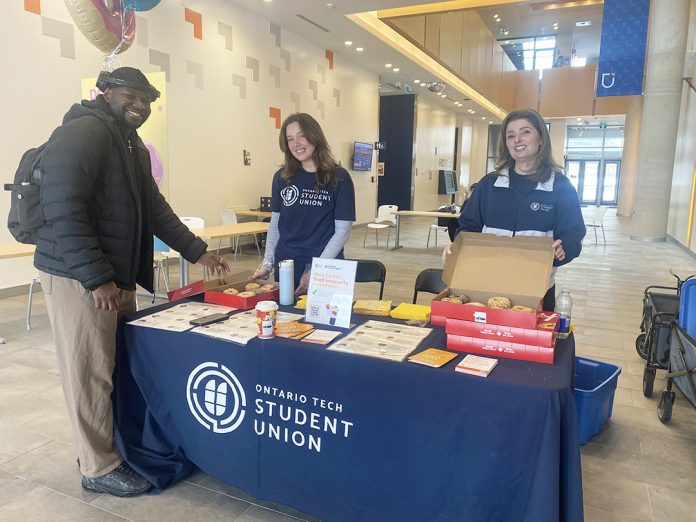
The Ontario Tech Student Union (OTSU) is currently piloting a Nutrition Access Program that provides students with free snacks every Monday, as well as a breakfast table on the first Wednesday of each month.
They launched in 2025 and have observed the positive impact on students.
“Having students tell me how they appreciate my work is truly the highlight of my day,” says Tuirani Kerfelec, vice-president of the OTSU.
It certainly isn’t easy work. Barriers need to be broken down and funds for food supplies need to be secured.
“It’s totally worth it when you see how students react and how excited they are about this,” Kerfelec says with a smile.
If students feel shame around getting help, she has some advice:
“If they’re scared of how they may look when they come seek support, the student union is here to support them.”
When you step through the doors of their office, you are greeted at the front desk with a warm smile.
Rahima Mazlomyar, the customer service representative at the student union has a lot of hope for this program.
“I feel like this can go somewhere really big,“ she says.
Mazlomyar sets up the snack tray every Monday and notices many students coming in to grab a quick snack.
She hopes it will eventually be something that can be offered daily.
“There are many doors that can open to the snack program.”
Addressing food insecurity is about more than just getting people through the day on an full stomach. It helping them go through the day with a full mind, heart and soul.