




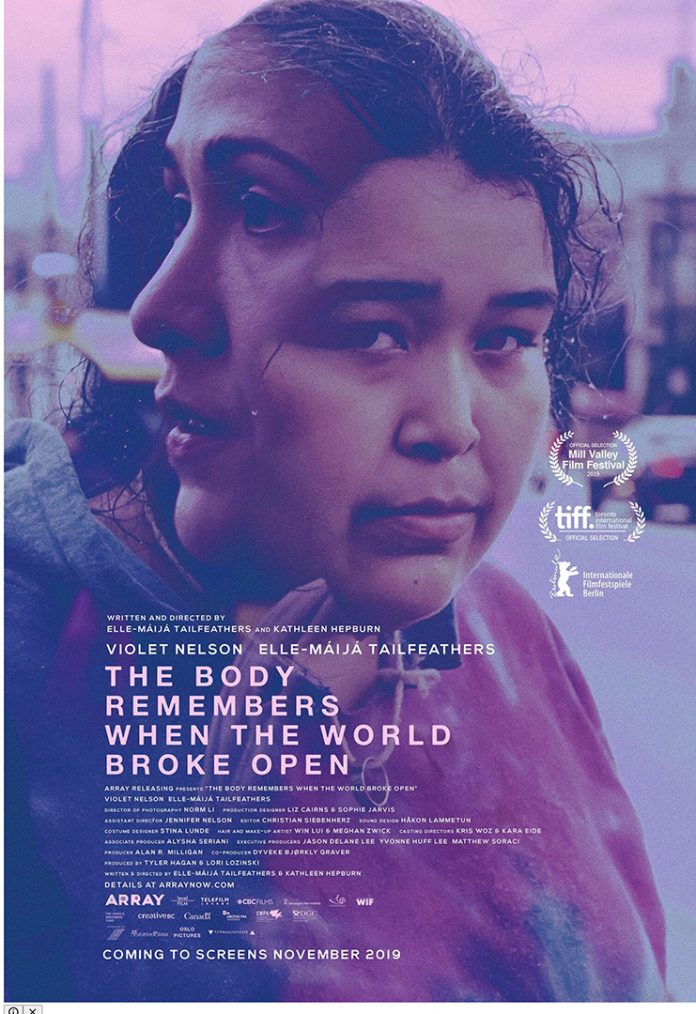

The Body Remembers When the World Broke Open shows how colonization and systemic harm live on in the body, instilling a deep, learned fear that speaking up or seeking justice will only lead to more silence.
Written and directed by Elle-Máijá Tailfeathers and Kathleen Hepburn, The Body Remembers When the World Broke Open, which premiered in 2019 at the Berlin Film Festival, is a story that unfolds throughout one day. What begins as a random meeting, becomes more than an encounter between two Indigenous women, brought together by chance. It becomes a connection through colonization.
The body has “broken open” long before the first scene.
The two main characters, Rosie and Áila, pass each other on the bus in the first scene, without making eye contact. An invisible thread. They have very different lives and destinations, but deal with the same impact of historical trauma.
When Rosie leaves the home that she shares with her abusive partner and his mother, her story unravels. She has been abused, threatened and is dealing with her pregnancy and throughout it all, still manages to find resilience. The violence Rosie experiences isn’t personal; it’s systemic.
The film keeps us with her, counting her shallow breaths and waiting through each anxious reply.
On the bus, Áila senses Rosie’s hesitation and gently takes her hand and guides her to her home. Her home represents a tidy, peaceful life, which is very different from where Rosie came from.
Rosie goes to the washroom to take a moment to breathe and during that time she turns to her baby for comfort. She holds her stomach and sings an Indigenous song, representing the connection she is forming with her unborn child.
Throughout the time Rosie and Áila are together, Rosie lashes out in anger and doesn’t sugarcoat her feelings. When Rosie is asked about going to a women’s shelter, she instantly tenses up.
She, understandably, does not feel supported through the system and does everything to avoid it. The criminal justice system has disproportionately over-policed, under-protected, and harshly punished Indigenous women while failing to address the systemic violence and colonial conditions affecting their lives.
The two main characters are not the only women in the film that are shaped by a complex, messy history.
The partner’s mother’s response to the abuse is to minimize, normalize and ignore it. This shows another Indigenous woman’s feelings towards the justice system; these weary responses mirrors how larger systems respond to Indigenous women experiencing violence.
Rosie finally, but hesitantly, agrees to go with Áila to the women’s shelter. She gets an opportunity to stay in a room but turns her back to it. The shelter has provided a procedure, not a future filled with justice or stability.
In the end, Rosie returns home, knowing that being at the shelter wouldn’t have solved the core issue: the cycles of gendered violence within marginalized communities.
The Body Remembers When the World Broke Open ends with no solution. It mimicks the real world and makes you uncomfortable.