




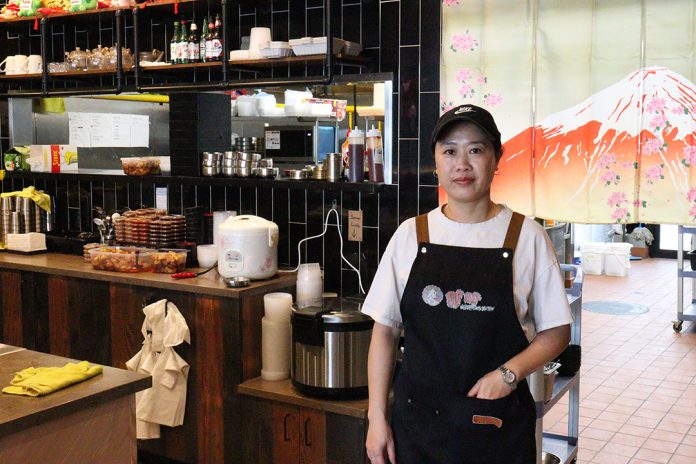

It’s been almost a year since Jenette Cao opened Mom’s Kitchen Korean Cuisine in Oshawa, her third location in Toronto area.
But like many restaurant owners, business has been slow.
“Compared to last year, my business dropped like 30 per cent,” said Jenette Cao, owner of Mom’s Kitchen Korean Cuisine in Oshawa.
According to Restaurants Canada, 53 per cent of restaurants were operating at a loss or just barely breaking even in 2024, a 12 per cent increase since the pandemic.
“After COVID, I would say the shipping cost has increased a lot,” said Cao.
She said about 80 per cent of her sourcing is local. However, goods like seasonings and ingredients for gochujang sauce need to be imported from Korea and vermicelli noodles are imported from China.
The 2025 Local Food Report shows that Ontario’s agri-food industry provides 54 per cent of the food consumed in the province.
Despite this factor, restaurants in the province face several structural cost barriers when importing goods.
A weaker Canadian dollar increases the cost of imported goods. Canada’s geographic size and supply chains from the U.S. and Mexico add transportation and storage costs, and U.S. tariffs and Canadian counter-tariffs have contributed to inflation.
Additionally, Ontario’s shorter growing season makes imports for many produce items a necessity.
Tania Clérac, executive dean of the Faculty of Hospitality and Horticulture Science at Durham College, said renewed interest in local and regional sourcing could offer a solution.
“Access to small-scale, local produce can reduce transportation costs, it can increase your freshness and quality, and can really create – I would say – some sort of a compelling local food narrative for customers,” said Clérac.
She said it’s less about replacing conventional supply chains and more about diversifying them. Restaurant owners would be less dependent on globalized supply chains and could diversify their supplier relationships.
“I think it’s part of a broader ecosystem approach for food resiliency,” said Clérac.
She thinks partnerships between food sustainability experts and restaurant owners could offer a way of educating business owners and encourage values of sustainability.
Cao said it would be a “really good idea” have more local produce available.
“I notice a lot of the vegetables that I order – even though I buy it from the local supplier – a lot of them, they import it from the United States or Mexico,” said Cao.
According to Statistics Canada, the country imported $5.5 billion in fresh produce from the U.S. in 2024.
Clérac said although local produce is not always cheaper on a per-unit basis, “it typically offers greater price stability, reliability and quality.”
Focussing on locally grown produce is possible; however, it can limit menu options.
For example, it would be difficult for some restaurants to rely solely on items grown in Ontario.
Still, Cao encourages other restaurant owners to buy local.
“It’s really beneficial for our economy system and I would love for our government to do a little bit more on growing our own produce products in Canada as well.”