




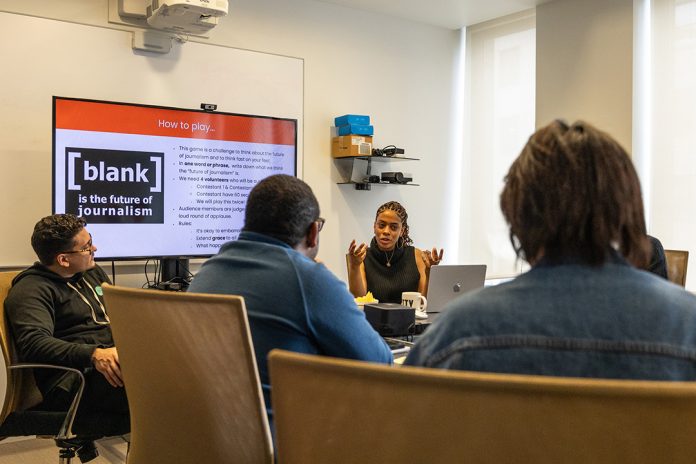

If Sierra Sangetti-Daniels, the community and Culture Steward of News Futures, had an unlimited budget and resources, she would open a television broadcast studio to create a News Futures network.
This imaginary national network for local news would allow people everywhere access to news for their area.
“We need community media centres. I think that we should start really investing in utilizing those small local community media centers,” said Sangetti-Daniels, a journalist, educator and media organizer.
Without proper coverage, we stand to lose local news in general.
According to a report from the Public Policy Forum (PPF), the lack of local news is worsening Canadian’s ability to make informed decisions in elections. The report shows 70 per cent of Canadians say an increase in local news would make them better informed.
In communities without local news, the report found that 63 per cent of people were unfamiliar with local candidates and 53 per cent were unable to find information about these candidates.
Toronto Metropolitan University’s Local News Research Project reported Canada has lost 242 local news outlets across the country since 2008, 22 of those being in the past two years alone.
“I think that we need to get some power: we need to get some ownership over local media. And I’m dying for someone to do something good on television. Please don’t let television news die,” said Sangetti-Daniels, who used to be an assignment editor at a local television station serving the Capital Region and Hudson Valley region of New York.
With a background in television news, Sangetti-Daniels co-founder of Peoples Perception Project, has both the confidence and the passion to make her venture a reality some day.
“I think it would be so cool if someone like News Features bought a network, then you could think about the shows, the channels and it would just be local news, but on the national network,” she said.
Sangetti-Daniels said local television news should not be a spectrum; we need community media centres so people are able to access news in their area instead of these broadcast stations being regional.
Now more than ever it is apparent something needs to be done about the decline in local news. This is where News Futures comes in.
News Futures calls itself a do-ocracy, which is a system that relies on a model where people who step up to do the work are empowered to make the decisions.
Founded in 2018 and based in the U.S., News Futures has a purpose: building a future for news that is service orientated, participatory and reparative.
News Futures believes everyone should have access to reliable news and local information that is actionable and relevant to their lives, regardless of location.
News Futures is made up of journalists who are dedicated to working towards social change. They use their journalistic platform to give marginalized and local communities a voice they do not normally receive in mainstream news media.
On the News Futures website, a Charter outlines principles available for anyone to sign. Signing the Charter gives someone access to peer-led working groups, a participatory fund and access to the Slack channel.
News Futures accomplish the goals of the Charter through working groups. Working groups are described by News Futures as any action-focused collaboration that advances the Charter.
They are used as a way for the News Future community to share their ideas, interests and journalistic work.
The working groups are supported financially and run by News Futures staff, with stewards like Max Resnik, running them.
Max Resnik is an active working group member who is not only part of several working groups but is a steward of his own working group called The Leaders. The goal is to “address the gap in leadership and management training within the industry.”
Resnik joined City Bureau, a non-profit civic media organization based in Chicago, Illinois, in 2021. There he began to work on expanding on the Documenter’s Network as director of network services.
The Documenter’s Network is a civic journalism lab that records and documents public meetings that go unnoticed at the local, regional and national level.
As the Documenter’s Network became popular in the U.S., Resnik got invited to speak about the work at the Engaged Journalism Conference, hosted by Magda Konieczna, associate professor at Concordia University, and Gabriela Perdomo, editor of J-Source.
Being already familiar with the concept of the Documenter’s Network, Konieczna made the decision, after listening to Resnik, that Canada needed their own version of Documenters.
“So two years ago, I worked with a graduate class to think about what it would be like to bring Documenters here,” said Konieczna who explores how journalism, democratic practice and community voices shape one another. “The following semester, I got to work trying to figure out what the process would be of making that happen.”
Konieczna created Documenters Canada to bridge the same gap found in public meeting coverage in Canada. Their first pilot project was launched in 2024 and is a partnership between The Green Line and Concordia University.
Konieczna, who used to be a city hall reporter in Guelph, Ontario, said the Documenters system helps put trust back in journalism.
“People feel like journalists have an agenda or are not telling the truth, but in this case, it’s your neighbours who are doing it, which helps people connect with the information that’s being produced,” she said.
The goal is to encourage community members to be active participants in the kind of news they report and share.
Konieczna said this system helps the state of local news as it allows community members effected by the outcomes of public meetings to be a voice for their community.
“It ensures local user information is relevant to communities by having people in the community produce which helps counter feelings of disempowerment or disengagement by training real people,” she said.
As of now, Documenters Canada has two places of operation, Toronto and Montreal. They are currently working on opening a smaller place in a rural area of Alberta called Crow’s Nest Pass.
“People who are like demonstrating with their feet that they want to be engaged, those are the ones that are like fueling the do-cracy,” said Sierra Sangetti-Daniels.
Looking to the future of local news, Sierra Sangetti-Daniels said journalists need to act fast and be innovative when changing how local news in order to keep up with the ever evolving pace of the media landscape.
“We have to do something fast, and I think the entrepreneur-like spirit is very important. We definitely need the go-getters to be go-getters right now,” she said.
As for the future, Sangetti-Daniels said News Futures is working towards their first convention in spring 2026.
We have our spring convention, which is going to be the first time that we’re doing a convention, so to say. We’re still working on like the language and the purpose behind it all,” she said.
Sangetti-Daniels said they also plan on coming back with more working groups in the new year as well as quarterly virtual sessions.
“We’re planning on coming back next year with more working groups and still looking to like have our quarterly virtual sessions,” she said.