




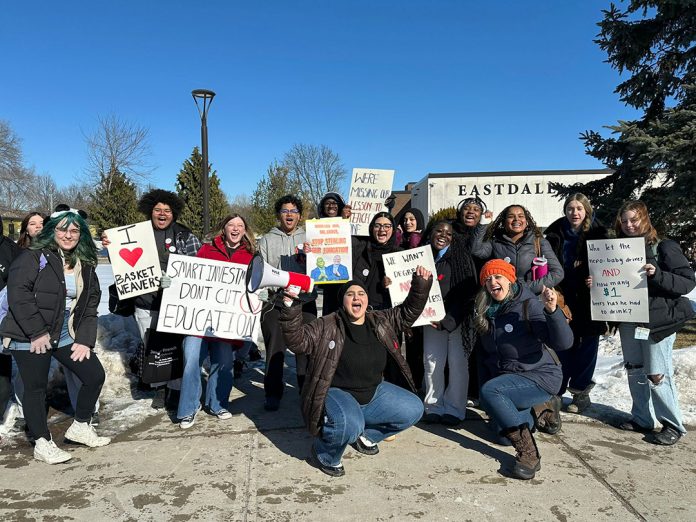

Ontario students are organizing walkouts and protests across the province in the face of major changes to the Ontario Student Assistance Program (OSAP).
OSAP, a financial aid program made up of both loans and grants, was created in 1966 following advocacy from students.
The program assisted about 440,000 full-time students in the 2023–2024 fiscal year, according to a report from the Ontario Ministry of Colleges and Universities.
Under the changes, the ratio of grants to loans will shift dramatically.
Previously, students could receive up to 85 per cent of their aid as grants and 15 per cent as loans. Beginning next school year, the maximum will shift to roughly 25 per cent grants and 75 per cent loans.
Multiple studies show that access to post-secondary education (PSE) increases earnings, particularly for youth from lower-income families. A 2019 Statistics Canada study highlights that this effect supports upward income mobility.
For many of them, financial aid is fundamental to accessing PSE.
When Finn Lefebvre, a first-year student in the Social Service Worker program at Durham College, heard the announcement, he immediately began thinking about the consequences for his own education.
“I’m very reliant on OSAP for education,” Lefebvre said, recalling the shock he felt when he heard the news.
The moment also sparked something else.
“I knew that there would be a lot of backlash from other students.”
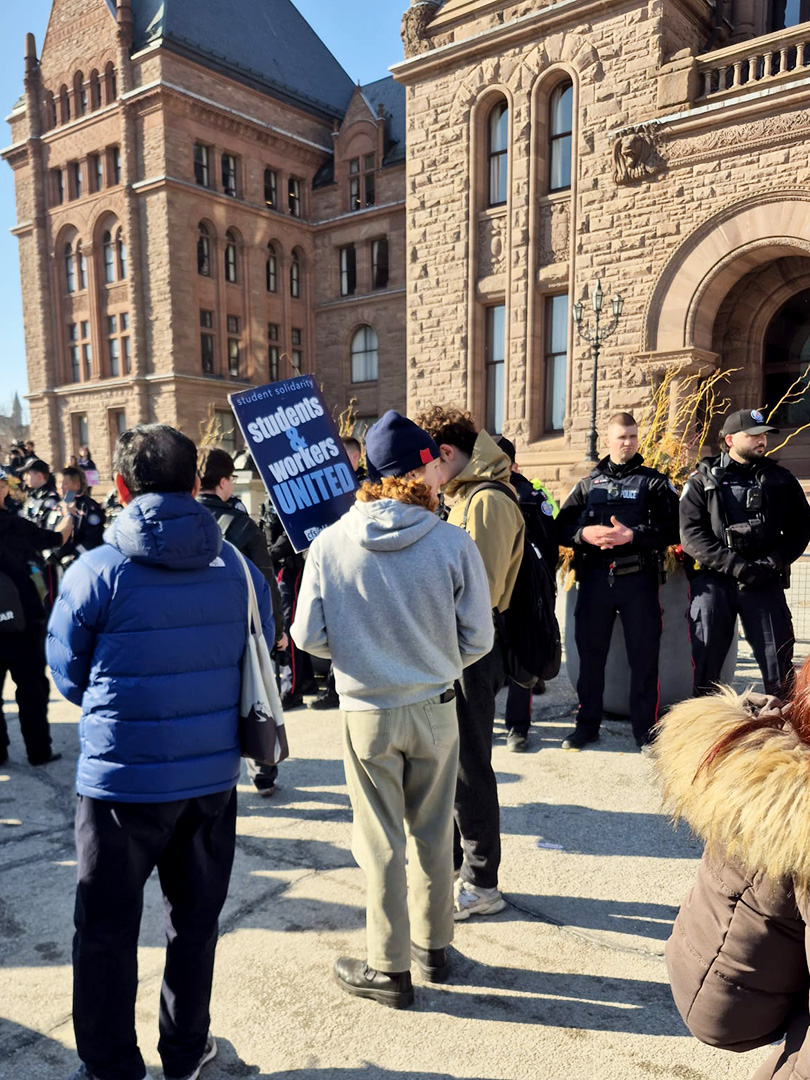
Lefebvre, who had no prior experience organizing, led the Durham faction at a recent protest at Queen’s Park.
“Half of domestic college students in Ontario are on OSAP, especially low-income families that struggle so much with affording college and the associated costs,” he said. “It’s very, very important to not just stand up for yourself, but your fellow students as well.”
He was not the only one to take action.
When Jannah Shah, a Grade 12 student at Eastdale Collegiate and Vocational Institute, heard the news with her friends, their first instinct was to organize a protest in Toronto.
Shah urged caution.
“Maybe as high school students, that wouldn’t be the most accessible thing to do,” she said, proposing an alternative.
“Why don’t we try to start a movement where students can organize walkouts at their schools to gauge numbers?”
To promote the idea, Shah did what many Gen-Z organizers do: she created an Instagram page.
At first, the response was slow.
Gradually, the account connected her with students across the region who shared similar concerns, said Shah.
“All of a sudden, I just started meeting all these students that had so much passion and really, really wanted to make a difference,” she said.
Students from high schools across Durham Region, many of whom had never interacted before, began organizing through Instagram direct messages.
Within a short time, walkouts were planned at roughly 20 schools.
But the organizing didn’t stop there. Students also created a template to send out to MPPs and Premier Doug Ford.
By that point, she said, the movement had grown beyond high school students and began involving broader community members.
“There’s that same anger toward the Ford government,” Shah said. “Quite frankly, you’re removing the tuition freeze while also cutting our OSAP. Our tuition is going up, but our funding is going down.”
Ajax MPP Rob Cerjanec, a Liberal and former student organizer, said reversing the policy will require widespread pressure.
“In order to get them to reverse course on this, everyone, students, but also their parents and communities, needs to get loud,” Cerjanec said.
Jennifer French, the NDP MPP for Oshawa and a former educator, met students from O’Neill Collegiate and Vocational Institute as they walked to Oshawa City Hall during one demonstration.
“We’ve got wonderful post-secondary institutions in our community,” French said. “What we should be doing is investing in them so they can provide the education students, employers and industry need right now.”
French added that rising costs and reduced aid could discourage some students from pursuing higher education.
“Potential students may choose not to pursue post-secondary,” she said.
The consequences extend beyond individual students, as argued by Cerjanec.
“It hurts our innovation. It hurts economic development. It hurts our economy,” he said. “You can’t have a strong economy without a strong education system.”