




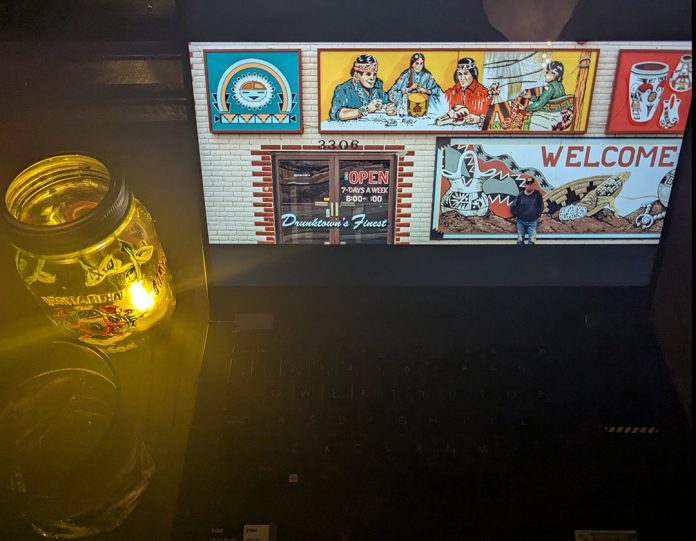

Scarcity is the backdrop of every scene in Sydney Freeland’s Drunktown’s Finest.
The prevalent substance abuse, desperate crime and poverty fill the town with quiet turmoil that is normalized within the community and disregarded outside of it.
Through the lens of three main characters, the 2014 film delves into how these issues circle back to systemic oppression and the many byproducts that maintain the cycle.
Sickboy is a soon-to-be father who lacks peace, Felixia is an aspiring model who lacks acceptance and Nizhoni is a teenage girl who lacks identity.
They all wander through the Navajo Reservation with no intention of staying.
Sickboy
Luther “Sickboy” Maryboy could easily be judged as a troublemaker but the film places his ambition and willpower alongside his mistakes. He is on his way to joining the army. He has more than enough motivation to get his life on track. He is juggling taking care of his younger sister, Max, and responding to his pregnant girlfriend’s need for him to stay out of trouble.
Sickboy does not reveal his trauma outright, but his familiarity with the police and nonchalance towards alcoholism show that he has not just witnessed crime and substance abuse, it has been part of his life.
His mother is a figure he avoids for most of the film, but when she does appear she is unstable and Sickboy instantly becomes tense. His anger boils over when a man, presumably his mother’s boyfriend, becomes violent with his little brother after offering him a sip of beer.
This interaction offers insight into the violence and substance abuse that was pervasive in his home and how one of each issues can lead to the other.
“When I was growing up, I used to think that being a drunk was just a part of life that everyone went through,” says Sickboy, played by Jeremiah Bitscui, a Navaho and Omaha actor who later appeared as Victor in Breaking Bad from Season Two to Season Four.
Sickboy describes alcoholism as the stage between puberty and adulthood. Though despite this belief, his trauma manifests through anger and violence.
His monologue about gun types and their efficiency gives an idea of Sickboy’s past, what he’s been exposed to. He speaks hypothetically, as if considering joining his peers, but remains adamant about steering from temptation.
But temptations draw closer every time he refuses them.
Felixia
Felixia’s need to appeal to others is financial and emotional.
As a sex worker, she becomes used to clients using her. Felixia’s dehumanization is protected by the colonial male imaginary perspective of Indigenous women being hypersexual and nothing more than a fetish. In many cases this has been used to excuse violence and murder of sex workers as if the work reflected their value, character or humanity.
This is coupled with fear and caution for Felixia as a transgender woman as the same men that lust over her don’t hesitate to disrespect her once they get what they want.
As a model she has reason to hope.
Felixia, played by Carmen Moore, has covered her bedroom walls in pictures of Navajo models and dolls herself up to become one of them. She is meek, yet confident in an audition to be a calendar girl and even fits the judge’s standards of an authentic Navajo model.
She is beautiful and connected to traditional culture, which sets her apart in auditions as the only model that can speak fluent Navajo.
She carefully follows the narrow path into the modelling industry, but there is always at least one person who uses her identity as a way to keep her in the same place she is desperately trying to escape.
Despite her efforts to evolve, she is reduced to her body and what it can offer others, whether it’s pleasure or a laugh at her expense.
Nizhoni
Nizhoni was adopted by white, Christian parents and this creates a set of barriers to self discovery. Although her parents treat her with love and care, their approach to her culture is dismissive and ignorant.
“I knew your parents. If I lived under those conditions, I would have drank myself to death too,” her adopted mother rants when she finds out Nizhoni, played by Morningstar Angeline, had been searching the reservation for traces of her past.
Her mother portrays a settler mentality, only acknowledging the struggles of the community as a way to steer Nizhoni away from it and cling to what she believes is right.
Although the fear of adopted children reconnecting with their birth families and never coming back is often shown in these kinds of plots, Nizhoni’s adopted mother never describes the Navajo people in a disparaging way.
Even though Nizhoni never blatantly agrees, she too dismisses some customs and beliefs of her own people. Due to her isolation, she actually experiences culture shock when her co-workers Copenhagen and Leroy Leroy refuse to pick up a dead owl, calling it a “silly Navajo superstition.”
While Nizhoni sees it as another dead animal to move out of the way, her co-workers alert each other of the omen signaling death.
She is embarrassed and uncomfortable when Copenhagen and Leroy Leroy scoff at her ignorance and make jokes that only native Navajo people would understand.
Despite being more comfortable and familiar with western culture, she does not feel complete without her Navajo side.
Her need for answers keeps her up at night and keeps her on the reservation.
Interwoven oppression
Sydney Freeland’s refreshing decision to focus on individual backstories and characteristics humanizes characters that would normally be portrayed as a monolith in popular media.
Oppression is a disadvantage, but the individual journeys show how it creeps into the characters’ lives and manifests in different ways, no matter the measures they take.
Despite where each character came from, their ancestral ties were borderless. They carried the trauma of their ancestors through modern indoctrination, dehumanization, and abuse.
Writer and director Sydney Freeland strays from shallow portrayals of these issues and delves into the intersectionality that exists in every community, but is rarely highlighted in depictions of Native ones.
Expanding on these details and watching them stretch to systemic factors shows why hard work and effort do not always guarantee success.
The misconception that laziness is the reason for harmful patterns does not hold up when systemic barriers threaten a community’s survival and well-being.
Drunktown’s Finest premiered at the Sundance Film Festival in 2014 and is now available on Amazon Prime Video.