




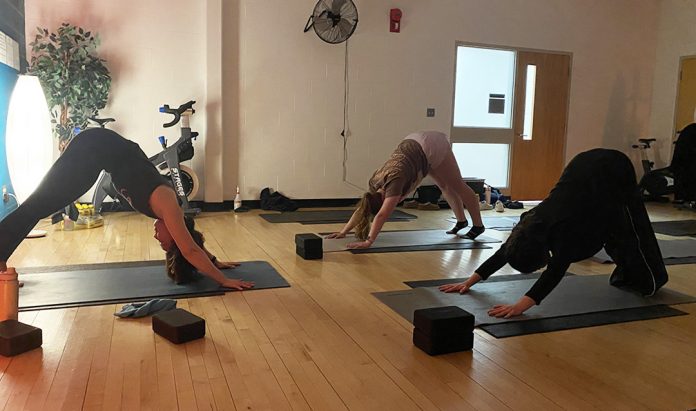

During “Power Hour,” an event at the Oshawa campus on Monday, students flowed through yoga poses while advocates and community organizations stood nearby, offering information about domestic violence awareness and support services.
The space held both stillness and strength.
Sgt. Angie Sitaram worked alongside Durham College’s fitness coordinator, Brianna Christopher, and health promotions coordinator, Jessica-Lee Bender, to put together the empowering event.
“If you don’t feel like you’re being heard,” said Sitaram, “that’s not a safe relationship. That is part of why we are here today, so people know the resources.”
The pairing of an open conversation about domestic violence with a yoga session wasn’t random; it was deliberate and thoughtfully planned.
“With domestic violence … it can be really challenging to maintain that relationship [with our bodies] and yoga is a fantastic practice that allows us a safe space to connect back to ourselves,” said Bender.
Christopher felt similarly about the combination.
“Any space where you find a moment to take a breath is really important,” she said.
According to Statistics Canada, more than four in ten women and one-third of men report being victims of intimate partner violence (IPV) in their lifetime.
“Having victim services involved [at the event] and getting the word out there normalizes it,” said Alex Reid, a counsellor with Durham Mental Health Services.
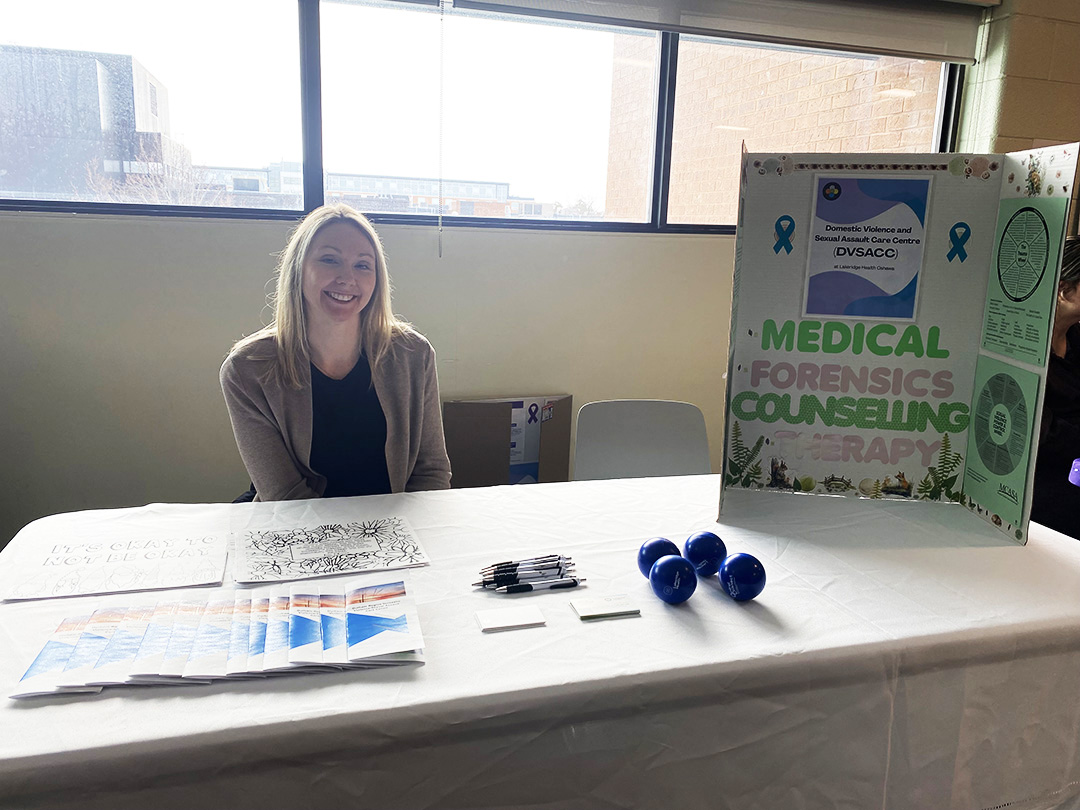
Other groups at the event included Durham Regional Police Service (DRPS) Intimate Partner Violence and Human Trafficking Units, Bethesda House, Denise House, Domestic Violence/Sexual Assault Care Centre at Lakeridge Health, Crisis Care Outreach, Ontario Shores Recovery College, First Peoples Indigenous Centre, DC CERT and the Student Development Office.
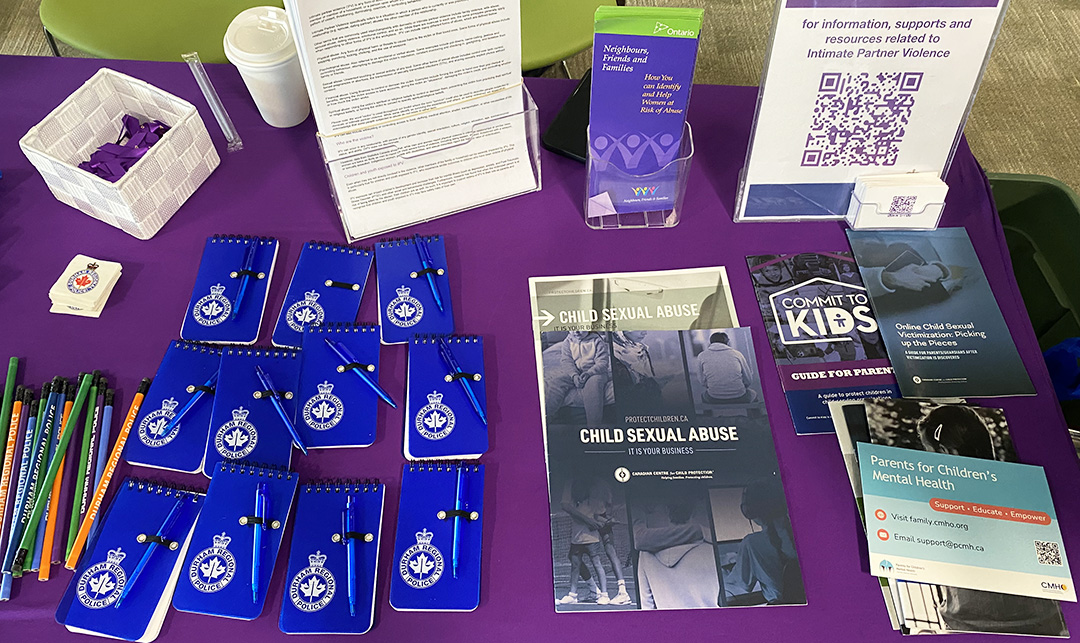
According to the Government of Canada, in “34 per cent of cases, people who have experienced IPV don’t speak to anyone about the violence that they experienced, let alone report it.”
Sitaram said it’s important for students to know what resources are available.
“I’ve worked in my roles in the Special Victims Unit and the Intimate Partner Violence Unit and some people just don’t know what to do when they’ve experienced gender-based violence,” she said.
Sgt. Stacey Sullivan of the DRPS talked about the importance of breaking down those barriers, “ensuring that people feel comfortable enough to come into a police station, or make a phone call and if not, to reach out to the resources here at the school.”
In the tabling room, conversations flowed.
Lisa Daugharty, a detective constable specialist in the Intimate Partner Violence Unit, said setting boundaries early on is crucial.
“This is how I expect to be treated and I will not navigate on that. I will not bend. I deserve to be respected and if you can’t respect me you are going to be held accountable,” Daugharty said.
Liza Baker, a placement student at the Bethesda House, reflected on her role in supporting people.
“Knowing that you are making a difference in helping people get out of those situations,” she said. “You’re doing just a small glimpse of something to help them better their future.”
After gathering information and resources from the booths, students transitioned from learning with their minds to reconnecting with their bodies.
“I’ve been a police officer for 23 years now and I wish I had found yoga sooner,” said Sitaram. “It is my biggest tool that I use to de-stress; I love it more than anything.”
Sullivan practiced yoga alongside Sitaram.
“There are a lot of stresses in this world regardless and I think yoga is a really good place to decompress and find a very non-stressful environment,” she said.