






Many of us would find it difficult to remember how many times we shared photos online or logged in to a website with our email or phone number in any given week.
But how is this digital footprint impacting online experience and safety? And what can we do to be less exposed and more secure as internet users?
During the recent Data Privacy Day on Jan. 28, Andrew Filson from the Centre for Cybersecurity Innovation at Durham College was at The Pit to answer these questions.
Filson is in his first year of the Computer Programming and Analysis program at Durham College.
“Data Privacy Day is all about bringing awareness to the changing landscape we have in the world today,” says Filson, adding that we lived in a pre-Internet world only a few decades ago, but now that internet usage is ubiquitous, the risks have increased as well.
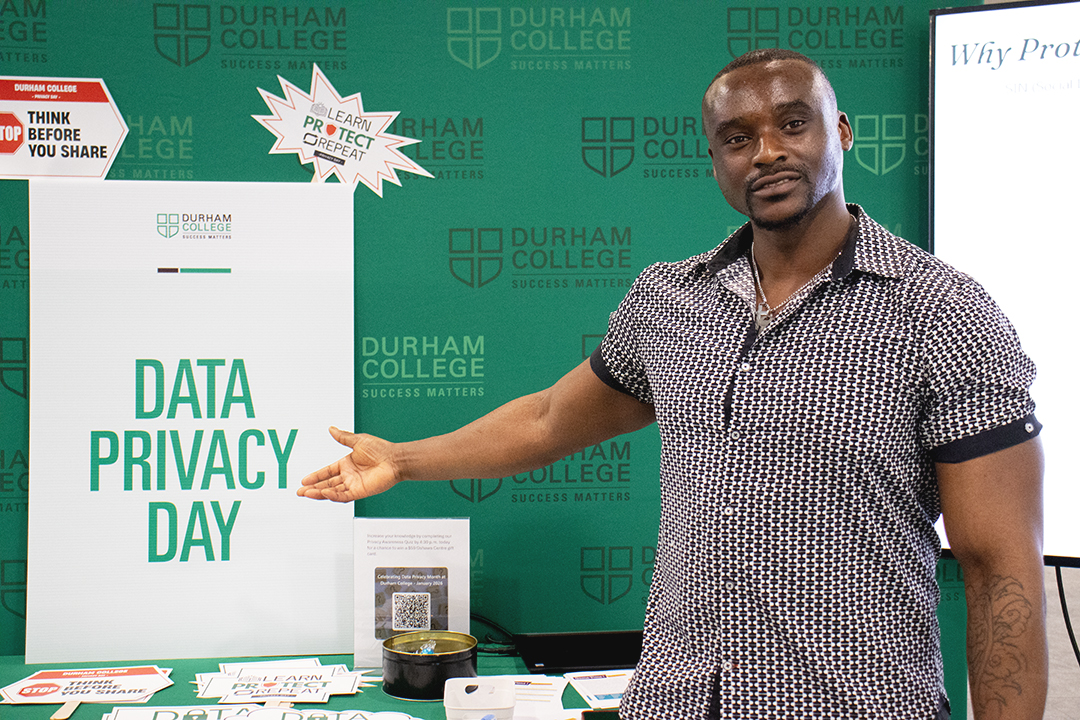
“While everything is online, most people don’t have the awareness of the simple things that we voluntarily agree to that can actually expose very sensitive information about us or about the places we go to, the things [and] services that we use,” he says.
Filson and his team set up a stall in the Pit where students could walk up and learn about digital hygiene and data privacy interactively.
By taking and uploading a picture of someone holding up one of the signs at the booth, Filson says his team showed how easy it can be to “scrape” information like the location, date and time it was taken, the device type, operating system and the specifications of the camera in the device.
“And this is something as small as an image file. Imagine what we could accomplish in managing what someone with malicious intentions could do,” says Filson.
According to the Canadian Anti-Fraud Centre, there were more than 33,000 victims of fraud and $544 million in losses as of last September.
Matthew Blakney, a second-year Music Business Management student at Durham College, says the advent of artificial intelligence (AI) makes it harder to tell what is real and creates new opportunities for scammers.
“Scammers and phishers, they try to take your voice in scamming calls, [and] they can do that with even one, two or three words,” he says. “If you say ‘hello’ to a scam caller, they can just take your voice, you can have a mistaken identity.”
Keertan Patel, a Master’s student in Ontario Tech University’s Business Analytics and AI program, advises people not to share personal details online with strangers. Patel also shared a personal experience of almost getting scammed.
“I was in tenth standard (Grade 10), and I got a random email [saying] that I had won a 10,000 rupees lottery from WhatsApp. Then I got to know it was totally fake and it wanted my personal details, like my bank account number,” Patel says.
Filson explains this method of obtaining sensitive information is called ‘social engineering,’ a method to “cleverly communicate and convince people to share information they would otherwise not be willing to share with you.”
There are several precautions one can adopt to stay safe online. Filson suggests turning off device location, using VPNs, keeping social media accounts private and limiting photo sharing. He also recommends being careful with public internet networks and using mobile data instead.
The Centre for Cybersecurity Innovation partners with government organizations to update security systems, provide training and run awareness campaigns, says Filson.
He encourages students to visit them in the Centre for Innovation and Research (CIR) to learn more.
“It takes a literal community to have proper data privacy and data hygiene,” says Filson. “So, please take care. Please be aware, be safe, and push for real data privacy and data hygiene in your communities, in your organizations, in the software that you use today. Because we need it now, not tomorrow.”