




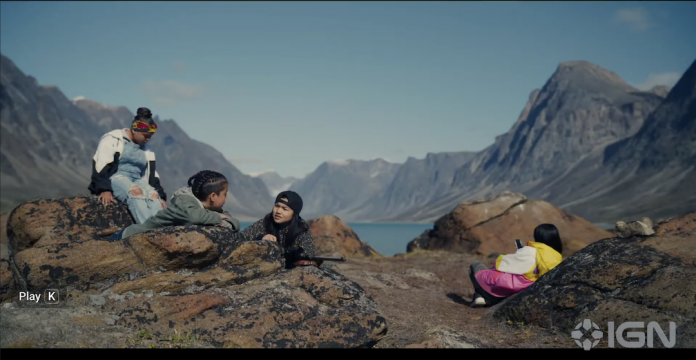

Slash Back (2022) is a young adult sci-fi movie set in a small Inuit community in Pangnirtung, Nunavut. Directed by Nyla Innuksuk, the film follows a group of teenagers as they cross paths with an alien creature best described as a Skinwalker or zombie that ‘wears’ dead bodies like skin and consumes blood, with tentacles projecting from its body.
What makes the movie distinct is not its science-fiction premise but the way it situates the narrative in the Inuit land and surroundings. The sparsity, isolation and ruggedness of the Arctic settlement of Pangnirtung are as much a part of the story as the characters.
Made for an all-ages audience, this film has a restrained, safer tone, making it mostly a feel-good story about an exciting adventure with friends instead of a ‘horror’ narrative. Along the way, the characters go through major character development and get further along in the process of figuring themselves out as people.
An adventure through Inuit eyes
Slash Back opens with a scene of a geologist, Tony Konk, getting killed by an unknown creature. Next, we are introduced to the home life of Maika, whose father (Atata) earns a living by selling meat, as the news of Konk’s death is being reported on their TV. This sets the stage for Maika to encounter this entity with her friends shortly afterwards.
The adults in the community have their own issues, which we learn about through the kids’ conversations. Their struggles with alcoholism and a fractured domestic life reflect the intergenerational ripples of displacement and colonial trauma.
The film may not have an overt political message, but it nevertheless does a good job of depicting Indigenous reality by showing the daily impacts of ongoing colonialism, without which it is almost impossible to depict Indigenous reality honestly. The film captures the complexity of contemporary life, where joy and community persist alongside systemic pressures.
The hostility of Officer Lefebvre towards the teens for having a quad bike but not a helmet is a window into how colonial structures continue to impinge upon the collective lives of Indigenous communities, and especially the vulnerable among them, such as minors.
In fact, the Inuit’s very presence in the region stems from forcible colonial relocation, despite which they continue to persevere by preserving their traditions, art and communal activities. Several Inuit communities were “forcibly relocated” from their ancestral homelands to the high Arctic in the 1950s and 60s. It took the Canadian government until 2010 to apologize for this relocation, and another fourteen to apologize to the Nunavik Inuit for the Nunavik Dog Slaughter aimed at destroying their way of life.
These realities are never declared or explained but are woven into the narrative, de-centring the normative viewer and re-centring Indigeneity.
As we are shown what daily life in Pangnirtung, or Pang, looks like, we can empathise with Maika’s frustration with its small horizons, which comes out as her lashing out at “Inuk shit,” or feeling embarrassed that her father sells food and meat for a living.
However, her friend Uki is set up as the foil who loves Pang and her people. Jessee models the ‘cool best friend’ trope, while Leena is a tall and lanky girl who is shy and not overtly brave or confident.
Ultimately, this is a coming-of-age story culminating in a ritual of hunting and protection. Within this frame, however, certain points in the plot become weak and predictable.
After their first sneaky trip to an out-of-bounds island, where the teens run into trouble with the mysterious alien presence, there is a convenient “social dance” that gets all the adults out of the picture for the kids to have their adventure.
Later, when the kids are trapped and calling their parents for help, no one answers because of the music and the drinks. And while the final scene of reporters descending on Pangnirtung only to ‘get the story’ is realistic, the initial news about Thomas Konk remains a loose end.
While this can be allowed, given the relatively low stakes and the film’s younger audience, there was scope for more imaginative writing at certain points. The alien entity itself is not explained much and is quite similar to that depicted in the 2019 film Color Out of Space, a Lovecraftian sci-fi horror film starring Nicolas Cage.
A story of redemption and assertion
The horror and sci-fi aspects of the movie take a backseat to the exploration of community and personal lives of the next generation of Inuit youth. The jump scares, chases, and mild violence provide the action, while the development of its main characters brings the drama.
Maika apologises to Uki for mocking her situation at home and heroically rescues not just Uki but her Atata, too. She applies her Atata’s hunting techniques to stake out and kill the two ‘Skins,’ i.e., the zombified Officer Lefebvre and the fisherman who spots them sneaking away from the dock in the beginning. In perhaps the most powerful sequence of the film, the teens gather their traditional weapons and mark their faces before the hunt, with Maika in a jacket that reads, ‘No justice on stolen land.’
When Jesse says, “no one can mess with the girls from Pang,” she is not just celebrating her friends but also asserting her Indigenous identity and the fact that they dealt with the threat themselves without needing an external saviour.
Towards the end, Maika is seen in a boat with her Atata, whom she saves from a Skin attack.
When he proposes turning back, she says, “No, I want to keep going,” since she has symbolically embarked on a journey of discovery and reclamation, surrounded by the majestic waters and rocky silhouettes of the Arctic landscape.
In the final scene, when a white, blonde CBC reporter holds her microphone through the shop window, Maika smiles and says she is “just a hunter.”
The events she survived proved her strength to herself and made her embrace her Inuk identity, not as a compulsion but a proud choice, made at the end of an internal struggle, resolved not individually but in community. After all, who can miss the significance of driving away the invading alien ship from what it claimed as its ‘new world’?