




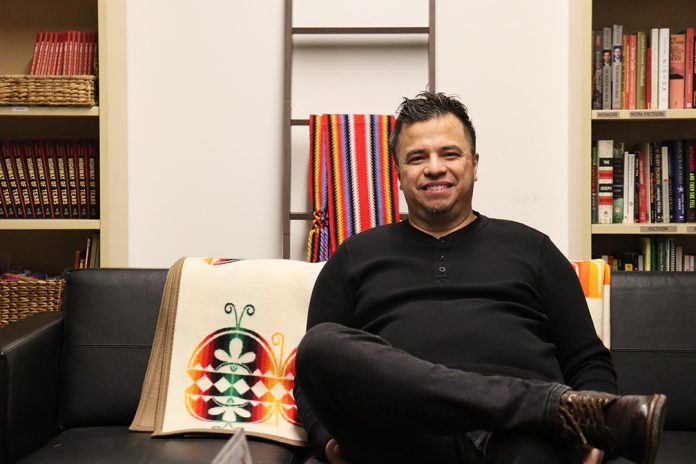

Saganaska Place, located in Belleville, Ont, is an affordable apartment building designed to provide off-reserve housing to both Indigenous people and residents.
After a series of opportunities, connections and timing, this was Asennaienton Frank Horn’s first project and what started his company Indigi-Solutions in 2024.
“I want to do something where it’s something tangible, meaningful,” he said.
Horn described himself as a “middle man,” who wants to help bring housing, broadband and transportation to Indigenous communities.
Indigenous housing in Canada remains a crisis, with overcrowding and substandard living conditions affecting communities across the country.
According to Statistics Canada, 17 per cent of Indigenous people lived in crowded housing and 16 per cent of Indigenous people lived in a place that needed major repairs in 2021.
Most Indigenous communities also have limited digital connectivity, both of which impede well-being and opportunity.
According to the Government of Canada, 24 per cent of Indigenous communities do not have access to reliable internet.
This is where Horn and Indigi-Solutions come in to bridge these gaps.
Horn started his career working for the Government of Canada in Indigenous and Northern Affairs. This gave him a foundational understanding of the Indian Act, funding agreements and the administrative barriers that can slow down progress.
He later worked with residential school survivors as part of a government program providing guidance and support.
Doing that, he saw firsthand the intergenerational trauma still shaping daily life. It pushed him to ask difficult questions, “OK, it happened, what am I going to do about it?”
That’s when he moved on to Canada Mortgage and Housing Corporation (CMHC). He was a First Nations housing specialist working with a team to directly help Indigenous people with housing.
“That’s where I really found my wings, so to speak, where I was able to work with the community directly and help them in an immediate need,” he said.
That is where he started building connections with the community. He learned to speak truth to power while working at CMHC when a mentor encouraged him to use his voice, not mute it.
That guidance prepared him for the realities of defending Indigenous interests in a sector where promises are often broken and trust is easily lost.
While working there, Horn had met Rick Summers, the CEO of Summers & Co., through hockey. Summers also worked in housing and wanted to get involved in Indigenous housing initiatives.
When Horn moved to Rogers, he realized housing isn’t the only critical infrastructure missing in many Indigenous communities. Broadband access is just as urgent. That insight pushed him toward helping with more than just housing.
Saganska Place started as a contract that was offered to Horn by a former colleague. He took it on while he was working at Rogers.
He balanced working there with putting together the contract and began pitching the housing contract to Indigenous communities he knew then reached out to Summers for the job.
“So even though I tried hard to keep this on the side of my desk and do those meetings in between my other meetings, it was hard,” he said.
He had gotten two Cree and Ojibwe communities on board, but he realized the project was in Belleville, which is Mohawk territory, so they insisted that Tyendinaga had to join as well.
After selling them on “the 11th hour,” they all signed contracts. “Literally, we had like less than a week left to kind of get everything together,” he said.
They put in the application, and along with Summers & Co., they won the property.
This project became the module for the work Horn does now. Bringing communities together to make change.
Horn said, “What I’m offering is a connection between two worlds.”
When a non-Indigenous company comes to Horn with an idea to help, he will vet it and ensure it is strong and helpful. Then he will go to the Indigenous community and see if they are interested in the idea and the partnership.
When picking a name, he said it took two months going back and forth. He got a close friend and former colleague, Sandra Willie, to help him.
He realized that what he was offering was solutions. “Solutions was very important to me. It’s about solutions,” he said.
When he launched the company, Willie also helped design the logo and artwork that represented his solutions-driven vision.
“I created his logo for him. He told me what he wanted. It took me, I think, a month and a bit to create the logo that he wanted,” she said.
There are a lot of motivations that got Horn to where he is now.
Horn said everything changed the moment he became a father. Holding his newborn daughter, he realized his career could no longer stay behind the scenes. “When she was born, that’s when things changed in my career,” he said.
He wanted her to grow up in a world where Indigenous children don’t face the barriers their parents and grandparents did.
“Her trajectory could have been different. The fact that she doesn’t have to worry about the things that other Indigenous people had to worry about before her time,” he said, “that’s the biggest motivation.”
His cultural roots also drive his purpose. Raised around Mohawk language, longhouse traditions and family teachings, helped shape his understanding of community responsibility.
That understanding helps him judge what partnerships are truly Indigenous-centered and which are performative. He knows when a proposal feels genuine and when it doesn’t.
“There are a lot of sharks out there,” he said, explaining why vetting is a core part of his work.
Horn’s effectiveness comes from credibility, something he earned over years of working directly with Indigenous communities. People trust him because he follows through.
“He’s always looking for ways to help us,” said Graham McWaters, a friend who runs the Indigenous Hockey Drive at Their Opportunity where Horn volunteers.
Horn understands the needs of the community and the language of government but most importantly, he knows how to bridge the two in a way that delivers results.
People already tell Horn that when they think of Indigenous housing, his name is the one that comes to mind. One even said he was her “Indigenous Google,” a compliment that has stayed with him.
“To me, that affirms my path where I’m going. I want to be someone who affects change,” he said.
That’s exactly where he hopes his future leads. “If you want Indigenous and housing,” he said, “I want to be the first one you call.”