





In the mid-eighties, a preteen Shellene Drakes-Tull anticipated the newest release from the Gazette De Quebec paper every weekend. With each page, she crawled further into worlds beyond Montreal’s borders. She travelled through positive and negative stories of different communities, but would always run into a hole.
The hole was big enough to fit the nuanced stories of her community, but was either half-filled by crime stories or left empty. Years went by, and Drakes-Tull grew eager to tell the stories of joy, innovation and accomplishments that she saw in the Black community.
As a university student, Drakes-Tull began writing for Community Contact, the only English and Caribbean community newspaper in Montreal.
“That opened my eyes to being able to tell stories of what was happening in my community, what we thought was important or what we wanted to share with everybody,” she said.
Drakes-Tull now walks through many intersections as a storyteller, educator, founder of Sweet Lime Communications and columnist at the Toronto Star. However, these roles didn’t always align.
Back in Montreal, Drakes-Tull cruised through her journey to journalism despite societal strikes against her as an English-speaking Black woman in Quebec. She had worked for local publications and studied at Concordia University, but prejudice towards Black people and English speakers marked a turning point in 1995.
The 1995 referendum to make Quebec a separate country created more tension toward English speakers. Drakes-Tull recalled then Parti Quebecois leader Jacques Parizeau crediting money and the “ethnic vote” as reasons for Quebec not being independent.
“I didn’t see any pathway to success for me in Montreal, especially after hearing stuff like that,” she said.
By 1998, Drakes-Tull had graduated and moved to Toronto, Ont., in search of more opportunities. She had landed an internship at the Toronto Star, but soon questioned whether journalism was right for her.
At this time, she began a 17-year corporate career at an accounting and telecommunications firm, a journey that challenged her creativity and identity.
“You had to be Black enough so that they can put on any paperwork that they have Black people working for them, not Black enough to make people uncomfortable. That’s really hard to do because you cannot be your full self,” Drakes-Tull recalled.
Getting her education and climbing the corporate ladder were at the forefront of her mind, but stepping on that ladder revealed barriers nobody had warned her about. Issues like racism, exclusion and doubt lengthened the spaces between each step, making each one harder to reach while still hovering above her.
As a child of Bajan immigrants, she viewed success through the lens of her parents, who came to Montreal in the 1960s. Although their emphasis on education and hard work was helpful, it did not factor in the stifling of one’s identity and what that does to the mind.
To help herself, Drakes-Tull had to question what success looked like to her as an individual. This drove her back to the holes in her community.
Building pathways and filling those gaps quickly became her new standard of success.
By time she left corporate in 2017, she had lost her sense of self.
Reaching laterally instead of upwards led Drakes-Tull to other Black women across Ontario with similar experiences in the workplace.
Realizing this was a broader issue inspired her 2021 book A Black Woman’s Guide to Navigating Corporate Spaces. The book is filled with information she wishes she had known before entering that space.
Messages in the guide run parallel to her student-based work, like the Modern-Day Griot project at the University of Toronto Scarborough (UTSC). The program pushes Black students to explore who they are before entering the workplace.
“The way she was able to build connections with them and hold their attention and gain their buy-in so fast is just a really good testament of her approach,” said Nadia Rosemond, Assistant Dean of co-curricular engagement at UTSC.

The program starts with the simple, yet loaded question “Who are you?” then goes through the process of interrogating media, stereotypes, origins and how they influence self-image. After about six weeks, the university students mentor high school students from the Durham District School Board (DDSB) as they spend a day at UTSC.
“From what we’ve learned from teachers from the DDSB, Black students don’t always think that going through post-secondary is an option for them. So we give them a taste of what it’s like and let them know, look, there are people who look like you who are on campus,” said Drakes-Tull.
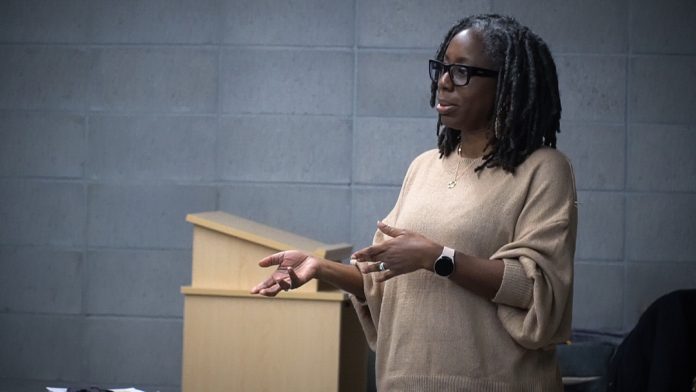
Rosemond, was an administrator in the Modern-Day Griot project, said she admired the brave, accepting and passionate nature of Drakes-Tull. She recalled a student trip to Howard University in Washington, DC, in which Drakes-Tull joined as a facilitator. She was surprised at the intimacy and depth that Drakes-Tull pulled out of students during conversation.

Photo credit: Celeste Ceres
“Too often we go into those spaces unsure of who we are, and people put all these stereotypes on us, and we make ourselves small to fit in and all it does is harm us,” said Drakes-Tull.
Drakes-Tull extended this approach to her communications firm, Sweet Lime Communications, but hit a roadblock with the COVID restrictions.
Using the Bajan slang “lime” to represent the exchange of information in innovative ways was a basis for the firm that explained the sweetness of sharing stories and opinions. However, another 2020 event brought sour emotions to Drakes-Tull’s work.
Drakes-Tull’s return to journalism came from the outrage over George Floyd’s murder in 2020. Several debates about justice, racism, brutality and profiling exposed global misconceptions about Black lives.
“The murder of George Floyd served as a catalyst for changing how we saw Black people in all different places.”
The discourse inspired her to share her frustration and relate it to how misconceptions about Black people lead to mistreatment in healthcare, work environments and beyond. Her opinionated LinkedIn posts brought journalism opportunities back into her life.
“Careers and what you want to do, it’s not necessarily a straight line…sometimes things come full circle,” said Drakes-Tull.
Returning to the Toronto Star as a columnist, Drakes-Tull aimed to share her voice differently. Making note of the unamusing strategies she had seen in the past, she now opts to combine journalistic skills with conversational strategies.
She often starts her opinion pieces with a personal anecdote, written in a blog-like style.
Drakes-Tull uses examples like sudden run-ins, finding lost items or any other relatable event that most would Tweet about or use in an Instagram caption. Drawing readers in with purpose, she guides them through a lesson about a broader issue in the world.
Drakes-Tull fills every hole in her path with authenticity, information and a personal touch. She maintains she would not have had the courage to write these strong opinion pieces before growing in her identity.
She said, “The self-actualization and self-knowledge, I think, helped me to be a more authentic storyteller, which then allows me to tell better stories.”